

Oral Science Journal
Is Hydroxyapatite Safe For Everyday Use?

Is Hydroxyapatite Safe For Everyday Use?

Hydroxyapatite went from a mystery to oral care's best-kept secret. It's shaken up an industry where legacy brands have used the same formulas for decades. If you're thinking about switching your family's toothpaste, or you already brush with it every day, it's fair to ask what you're putting in your mouth twice a day. So, is hydroxyapatite toothpaste safe?
Short answer: yes, hydroxyapatite is safe for daily use. It’s the same mineral your enamel is made of, it’s been used in toothpaste in Japan since the 1980s, and Europe’s scientific safety committee has reviewed it for toothpaste use. Here’s what the research says, plus the few trade-offs worth knowing before you switch.
Is hydroxyapatite safe?
Yes. Hydroxyapatite is a naturally occurring form of calcium phosphate. It makes up about 97 percent of your tooth enamel and much of your bones, so your body already recognizes it.
The hydroxyapatite in toothpaste is made in a lab to match the structure of natural enamel crystals. Manufacturers combine calcium and phosphate under controlled conditions, then process it into fine particles that can reach the tiny gaps in your enamel. Some brands use micro-sized particles, while others use nano-hydroxyapatite, which is small enough to settle into the smallest defects.
Its safety record goes well beyond toothpaste:
-
Medicine and dentistry: Synthetic hydroxyapatite has been used for decades in bone grafts and to coat dental implants, because the body accepts it instead of rejecting it.
-
Japan: Hydroxyapatite toothpaste has been sold there since the 1980s, and in 1993 Japan approved hydroxyapatite as an anti-cavity ingredient.
-
Europe: The European Commission's scientific safety committee reviewed nano-hydroxyapatite and concluded it's safe in toothpaste and mouthwash, within set limits on concentration and particle shape.
What are the benefits of using hydroxyapatite regularly?
Hydroxyapatite works best when you use it regularly. Acid from food and drinks pulls minerals out of your enamel all day long, so your teeth benefit from steady support. Brushing with it regularly can help:
-
Support your enamel. Studies have shown hydroxyapatite can help remineralize early enamel lesions, the first areas of mineral loss.
-
May ease sensitivity over time. Sensitivity happens when tiny open channels in your dentin let hot, cold, and sweet sensations reach the nerve. Laboratory research has shown hydroxyapatite can help block those channels, and clinical studies have found improved sensitivity with regular use.
-
Brighten without bleaching. Laboratory research suggests hydroxyapatite may contribute to a brighter-looking smile, without peroxide.
-
Help keep bacteria from sticking. In small studies, rinsing with hydroxyapatite reduced how much bacteria stuck to enamel, without killing them. Researchers think the particles may make it harder for bacteria to attach to your teeth.
-
Fluoride-free for the whole family. With no fluoride, there’s no fluorosis concern, which is one reason many parents look into it for kids still learning to spit. Your child’s dentist can help with the right amount for their age.
Are there any risks to using hydroxyapatite?
Hydroxyapatite has no known serious side effects at the levels used in toothpaste. Still, there are a few trade-offs to know before you switch:
-
Less long-term research than fluoride. Fluoride has decades of large studies behind it. The research on hydroxyapatite is solid and growing, but there's less of it.
-
It can't fix a cavity. Hydroxyapatite helps with early enamel loss. Once decay breaks through into a cavity, you need a dentist.
-
Quality varies by brand. Concentration, particle size, and particle shape all affect how well a toothpaste works, and some formulas include only a small amount.
-
It costs more. Hydroxyapatite toothpaste usually costs more than a standard fluoride tube.
-
Foam varies by brand. Some hydroxyapatite toothpastes skip foaming agents, so lather can feel different from what you’re used to.
If you have a dental condition or a high risk of cavities, ask your dentist which toothpaste fits your needs.
How does hydroxyapatite work to safely remineralize teeth?

Your enamel is a lattice of hydroxyapatite crystals. Every time you eat or drink something acidic, the pH in your mouth drops. Once it falls below 5.5, acid starts pulling calcium and phosphate out of that lattice. Saliva works to put those minerals back, but frequent snacking and sipping can tip the balance toward loss.
Researchers believe hydroxyapatite helps in a few ways:
-
Particles attach to the enamel surface and settle into microscopic defects.
-
When acid rises, hydroxyapatite releases calcium and phosphate into the weakened areas of your enamel.
-
Those minerals build back into the enamel crystals already there.
-
In exposed dentin, particles plug the open channels that cause sensitivity.
Because it adds back the same mineral your teeth are already made of, it doesn't change what your enamel is made of. That's a big reason it's considered so safe: there's no foreign compound for your body to deal with.
How does Larineco™ use hydroxyapatite?

Every Larineco™ formula is made with hydroxyapatite, for everyday enamel support.
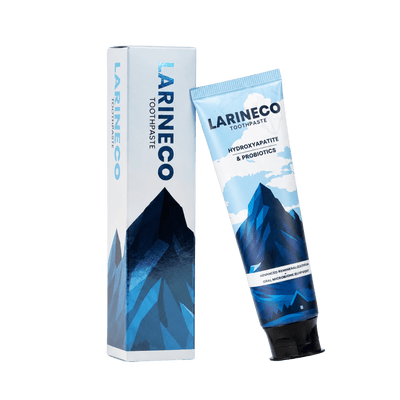
Larineco™ Remineralizing Toothpaste is formulated with 15 percent hydroxyapatite, while plenty of tubes on the shelf include 5 percent or less. It also includes probiotics to support the good bacteria in your mouth and keep your pH closer to neutral, where remineralization works best.
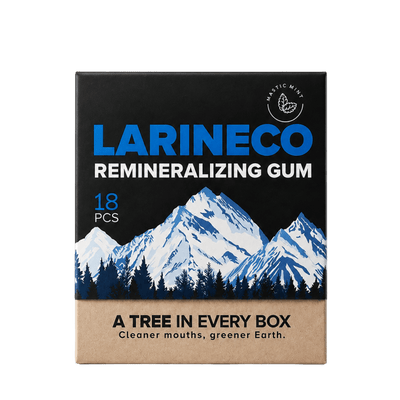
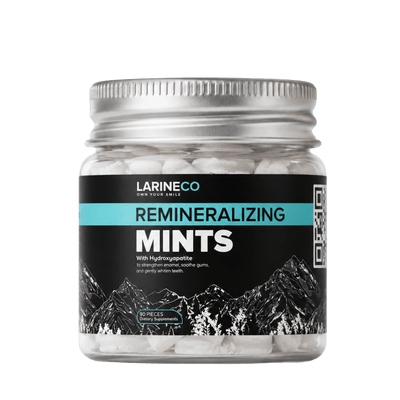
Larineco™ Remineralizing Gum pairs nano-hydroxyapatite with xylitol. Chewing it gets your saliva flowing and helps clear food acids, which makes it a good fit after meals and coffee, when your mouth is most acidic. In a 30-day consumer study, 84% of participants said their breath felt fresher and 87% said their mouth felt clean and refreshed.** Larineco™ Remineralizing Mints bring hydroxyapatite with you on the go, for the moments when chewing gum isn’t an option, like in a meeting or on a call.
**Based on participant-reported results after 30 days of once-daily use in a single-group, open-label study; n=38 at Day 30.
Together, they make up the Enamel Starter Kit, a full-day routine built on the idea that enamel care shouldn’t stop at the sink. In our gum study, 95% of participants said it was easy to fit into their daily routine.** We believe oral care goes beyond your morning and night brush, and that your teeth and entire mouth need support throughout the day.
Frequently Asked Questions
What are the long-term effects of using hydroxyapatite?
Hydroxyapatite has been used in toothpaste in Japan for over 40 years and in bone grafts and dental implants for decades. With steady daily use, it’s designed to support stronger, smoother enamel.
What Larine products use hydroxyapatite?
Larineco™ has a hydroxyapatite product for every part of your day:
-
Morning and night: Brush with Larineco™ Remineralizing Toothpaste, made with nano-hydroxyapatite.
-
After meals: Chew Larineco™ Remineralizing Gum, made with nano-hydroxyapatite.
-
On the go: Reach for Larineco™ Remineralizing Mints, made with hydroxyapatite.
-
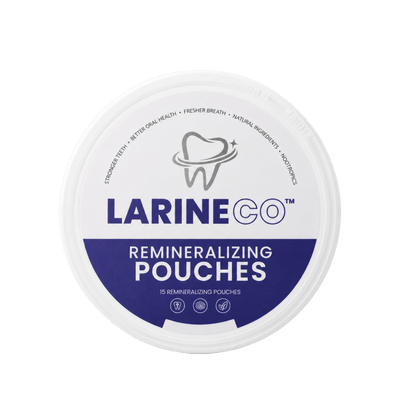
While you work, train, or drive: Use Larineco™ Remineralizing Pouches, made with nano-hydroxyapatite.
Is hydroxyapatite suitable for sensitive teeth?
Research suggests it can help. Lab studies have shown hydroxyapatite can help block the open channels in dentin that lead to the nerve, and clinical studies have found improved sensitivity with regular use. In our own 30-day consumer studies, 78% of toothpaste users and 66% of gum users said their teeth felt less sensitive.*
*Self-reported results from single-group, open-label studies: toothpaste used twice daily, n=37 at Day 30; gum used once daily, n=38 at Day 30.